QBD-nano are extremely compact Pockels cell drivers (4.0 x 3.0cm) producing up to 5 kV bipolar voltage pulses.
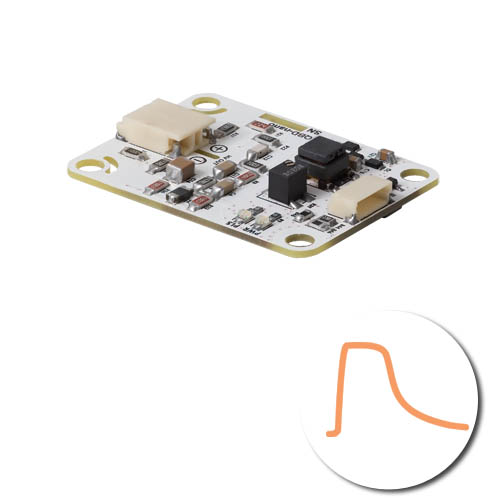
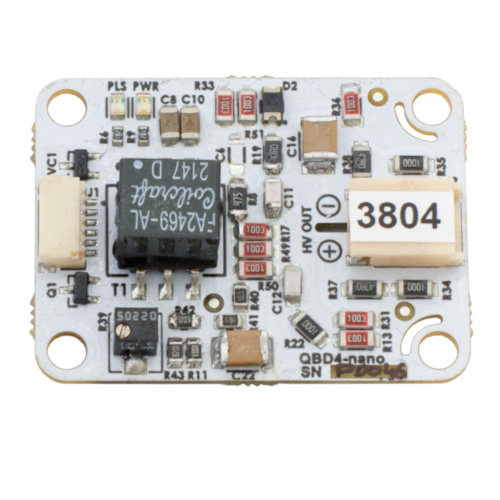
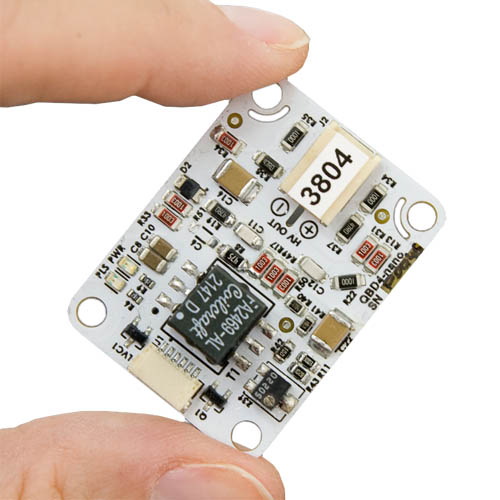
Good for Q-switching and cavity dumping.
QBD-nano is specially designed to control Pockels cells by applying a fast switching high voltage. Good fit for q-switching and cavity dumping. The module requires +5 V DC power supply and a pulse generator to set an operating frequency. The output voltage can be programmed from approximately 75–85% of UMAX up to UMAX by user either manually (through onboard configuration trimpot) or automatically (applying a DC voltage between respective pins).
There is only one possible modification of output signal type, push-up (= normally off scheme), when a base voltage level equals to zero

QBD-nano is based on avalanche transistors and offers fast transition time for a leading pulse edge. The recovery time by QBD-nano is relatively long (5-10 μs for the trailing pulse edge vs 1-3 ns by QBU-nano).
QBD-nano has some duration (on-time, "shelf"). It could be choosen at the time of order in 0.5-1 μs range. By default, it is 0.6-0.8 μs.
As alternative Q-switch driver, please kindly find:
QBD-series, up to 6 kV.
QBD-mini, compact version of QBD, up to 4 kV
Advanced Q-switch drivers are more improved, allow to change an output voltage level and advanced switching control to vary pulse repetition rate and width (long pulses, from 200 ns to CW). They provide pulses with both fast edges (< 15-20 ns) and allow to switch high voltage on the cryslal shortly before pull-down pulse to prolongate the crystal life-time.
QBU-series, up to 6 kV.
QBU-mini, compact version of QBU, up to 4 kV
QBU-mini-SP, compact version of QBU with short pulses, up to 4 kV
QBU-10kV-series, up to 10 kV.
(*) Other modifications are available on request. For example, low-profile version with smaller transformer and 2-3 times lower performance is available on request (see also the User manual).


