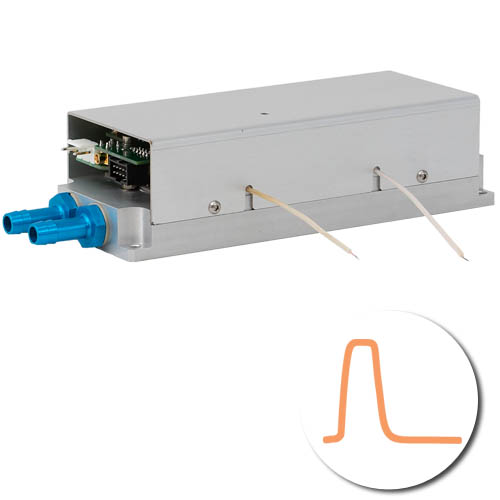
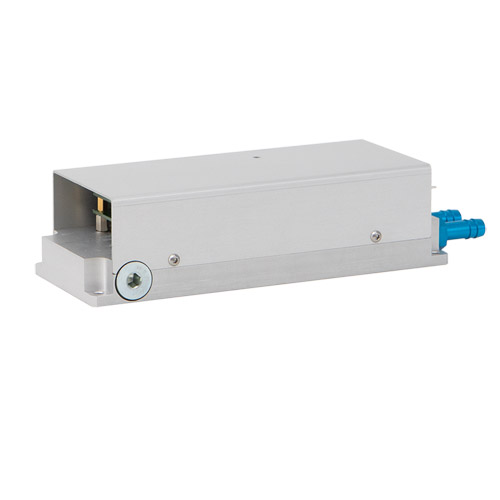
HVSW-04 is a combination of two fast drivers (based on MOSFET technology) in a full-bridge schema, the primary use is for extracting single pulses from a pulse train (pulse picking) and regenerative amplifier control.

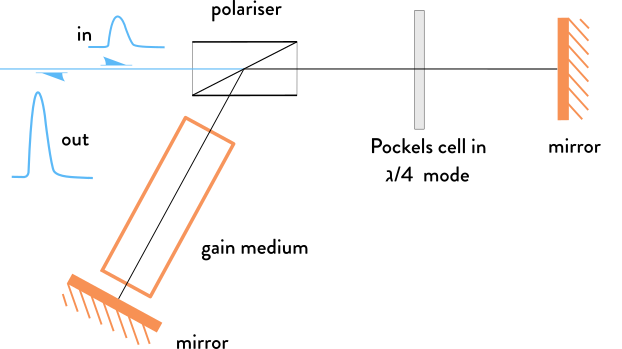
Two different operating modes by output pulse width are possible:
• fixed width short pulses (about 15-20 ns), triggered by a leading edge of an external TTL
• long pulses with variable width (100-2000 ns range typically, other on request), when a leading edge of an external TTL signal cause rise of pulse, and a trailing edge cause pulse fall
We offer also a wide range (-WR) driver modifications with a continiously adjustable in range of 15-2000 ns pulse width, but pulse amplitude in this case is slightly less than DC input voltage (by 10-15%, in dependence on load)
The maximum output voltage is 4 kV bipolar, the maximum repetition rate is 0.5-4 MHz (in dependence on output voltage, actual load capacitance and cooling conditions). Driver is water cooled.
The module requires +24 V DC power supply and pulse generator to set an operating frequency and pulse width (in long pulse mode) and a HV DC bipolar power supply (e.g. HVPS-300). An output voltage level is exactly the same as the HV DC input from external power supply (for standart version of HVSW-04, 0.85-0.90 of this level for -WR version), so it set by user using an interface of the HV DC power supply. It is possible to control the driver through analogue interface or through RS-485 interface (not simultaneously!). PC software is available for lab purposes.
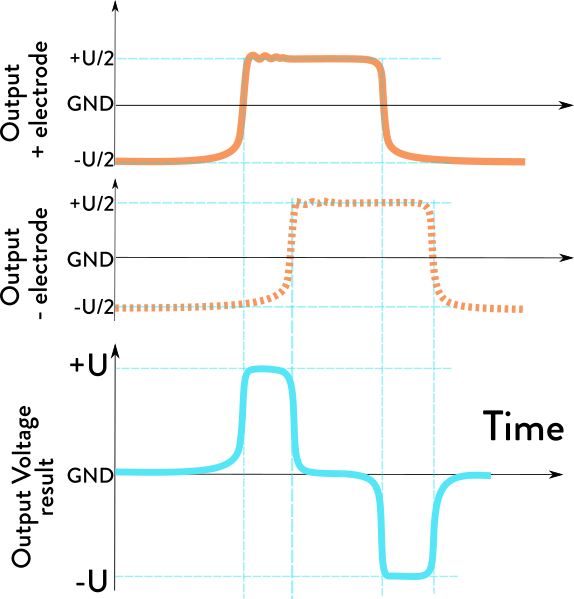
Output voltage result in case of full-bridge driver topology represents pulses of alternating polarity:
Please, also take a look at HVSW-03 MHz-class driver without water cooling.
Input:
+HV/2 to one pole; -HV/2 to another pole
Output:
Voltage, high level
regulated, up to 4 kV1, 2 (the same as voltage, applied to HV Input)
Voltage, base level
fixed, 0 kV
1
Maximum repetition rate
up to 4 MHz 2
Minimum repetition rate
single shot
Pulse width
15-20 ns fixed (in fixed pulse width mode)
100 ns - 2000 3 ns adjustable (in variable pulse width mode)
15-2000 ns for -WR (wide range) modifications (variable pulse width mode only)
Minimum interpulse interval
< 100 ns in standard versions (~60 ns typically)
< 200 ns in FX version (see also How to order? section)
Rise / fall time
from 5-7 ns at output voltages ~1 kV
to 9-11 ns at the max. voltage (4 kV) 4
Load capacitance
5-7 pF typ.
Environment:
Operation temperature
+10 … +40 °C (wider temperature range is available on request)
Storage temperature
-20 … +60 °C
Humidity
0 ... 90%, non-condensing
Other:
Protection
- from too long pulses (Gate limit), adjusted by the customer in 200 ns to 2000 ns range3
- from overheating (max. allowed temperature is 50 °C by default)
Size (LxWxH)
176x69x50 mm
1)
In terms of bipolar output
2)
these parameters aren't indepenent and cannot achieve their maximum at the same time
3)
these and other parameters could be changed upon request
4)
10-90% level, guaranteed at load capacitance 5-7 pF and below
Modifications
The driver could be damaged at higher voltages and repetition rates!
HVSW-04-XXX-[WR]-[FX], where:
-
XXX means voltage modification, might be either 4kV (most standard version) or 2kV (high repetition rate version)
-
WR means wide (15-2000ns) pulse width adjustment range (option, please see Manual, p. 11-13 for the details)
-
FX means version of the device with fixed polarity of the output pulses (option, please see Manual, p. 11-13 for the details)
Difference between 2kV and 4kV modifications:
| Modification |
Maximum repetition rate |
Maximum voltage |
Rise time / fall time |
| HVSW-04-4kV-[WR]-[FX] (standard modification, 4kV max) |
1MHz (can be damaged if operated at higher repetition rate) |
4kV (can be damaged if operated at higher voltage) |
9-11ns
(at 4kV) |
HVSW-04-2kV-[WR]-[FX]
(high repetition rate modification, 2kV max) |
4MHz (can be damaged if operated at higher repetition rate) |
2kV (can be damaged if operated at higher voltage) |
7-9ns
(at 2kV) |
Base version (4kV):
- Up to 4.0 kV output voltage
- Up to 1 MHz repetition rate (at 3.2 kV voltage)
- 9-11 ns rise / fall time (at 4 kV voltage)
- Short pulse (15-20 ns, fixed) and Long pulse (100‑2000 ns, adjustable) modes of operations, 20‑100 ns range is unavailable
- Polarity of sequential pulses – alternating
High repetition rate version (2kV):
- Up to 2.0 kV output voltage
- Up to 4 MHz repetition rate (at 1.6 kV voltage)
- 7-9 ns rise / fall time (at 2 kV voltage)
- Short pulse (15-20 ns, fixed) and Long pulse (100‑2000 ns, adjustable) modes of operations, 20‑100 ns range is unavailable
- Polarity of sequential pulses – alternating
Version with fixed polarity of the output pulses (4kV):
- Up to 4.0 kV output voltage
- Up to 1 MHz repetition rate (at 3.2 kV voltage)
- 9-11 ns rise / fall time (at 4 kV voltage)
- Short pulse (15-20 ns, fixed) and Long pulse (100‑2000 ns, adjustable) modes of operations, 20‑100 ns range is unavailable
- -
Polarity of sequential pulses – the same
High repetition rate version with fixed polarity of the output pulses (2kV):
- Up to 2.0 kV output voltage
- Up to 4 MHz repetition rate (at 1.6 kV voltage)
- 7-9 ns rise / fall time (at 2 kV voltage)
- Short pulse (15-20 ns, fixed) and Long pulse (100‑2000 ns, adjustable) modes of operations, 20‑100 ns range is unavailable
- Polarity of sequential pulses – the same
4kV base version with wide pulse width adjustment range:
- Up to 4.0 kV output voltage
- Up to 1 MHz repetition rate (at 3.2 kV voltage)
- 9-11 ns rise / fall time (at 4 kV voltage)
- Continuously adjustable pulse width in 15-2000 ns range
- Polarity of sequential pulses – alternating
High repetition rate version with wide pulse width adjustment range (2kV):
- Up to 2.0 kV output voltage
- Up to 4 MHz repetition rate (at 1.6 kV voltage)
- 7-9 ns rise / fall time (at 2 kV voltage)
- Continuously adjustable pulse width in 15-2000 ns range
- Polarity of sequential pulses – alternating
4kV base version with wide pulse width adjustment range and fixed polarity of the output pulses:
- Up to 4.0 kV output voltage
- Up to 1 MHz repetition rate (at 3.2 kV voltage)
- 9-11 ns rise / fall time (at 4 kV voltage)
- Continuously adjustable pulse width in 15-2000 ns range
- Polarity of sequential pulses – the same
High repetition rate version with wide pulse width adjustment range and fixed polarity of the output pulses (2kV):
- Up to 2.0 kV output voltage
- Up to 4 MHz repetition rate (at 1.6 kV voltage)
- 7-9 ns rise / fall time (at 2 kV voltage)
- Continuously adjustable pulse width in 15-2000 ns range
- Polarity of sequential pulses – the same
Example
Up to 4.0 kV output voltage, up to 1 MHz repetition rate, fixed polarity of the output pulses