Product Detail

HVSW-03 Pockels Cell Drivers

HVSW-03 is fast MHz-class driver for pico- and femtosecond lasers.
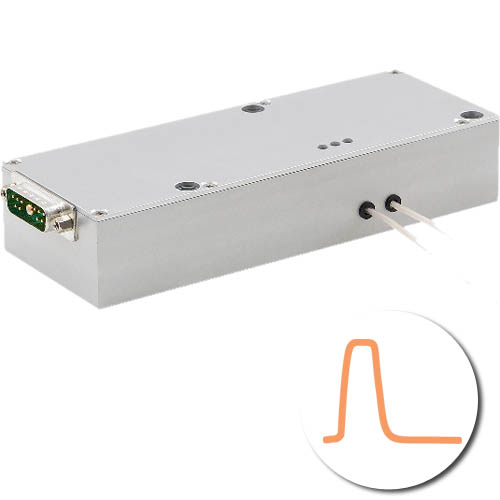
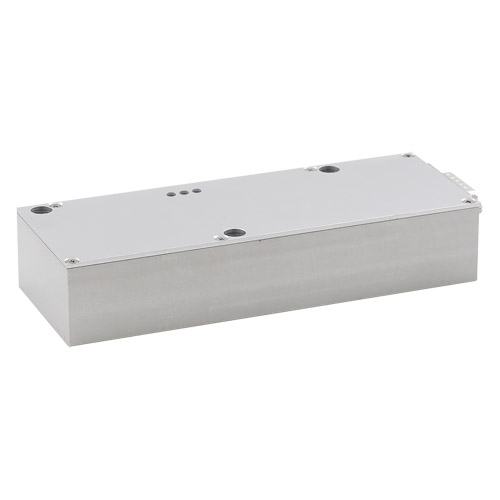
HVSW-03 Pockels cell driver 1
HVSW-03 Pockels cell driver 2

Fast-switching driver, suitable for pulse picking & pulse slicing, cavity dumping, regenerative amplifier control.

  • Repetition rates up to 1 MHz @ 1.5 kV, 2 MHz @ 1.0 kV
  • Up to 2 kV output voltage
  • 6-8 ns rise time and fall time
  • Two operating modes: short pulse (10-15 ns, fixed width) and long pulse (100-2200 ns, adjustable width)
  • Integrated high voltage power supply

HVSW-03 is a dedicated high voltage high repetition rate Pockels cell driver for pico- and femtosecond lasers. It represents a combination of two fast drivers (based on MOSFET technology) in a full-bridge schema, the primary use is for extracting single pulses from a pulse train.

pulse picking, pulse picker schema

Using the driver one chooses between two operation modes:
• fixed width short pulses (about 10-15 ns), triggered by a leading edge of an external TTL.
• variable width long pulses (adjusted in range of 100-2200 ns typically, other on request), when a leading edge of an external TTL signal cause rise of pulse, and a trailing edge cause pulse fall.

The maximum output voltage is 2 kV bipolar, the maximum repetition rate is up to 1-2 MHz (in dependence on output voltage, cooling conditions and device modification). Driver’s bottom surface is a heat dissipating area for cooling the device, so we recommend using either a massive chassis, a heat sink or a cold plate to attach the driver.

The driver requires +24 V DC power supply and a pulse generator to set an operating frequency and pulse width (in variable pulse width mode). There is no need for a separate DC high voltage source. An output voltage level is set by user using an analogue interface or base interface RS-485 and provided PC software.

Output voltage result in case of full-bridge driver topology represents pulses of alternating polarity:
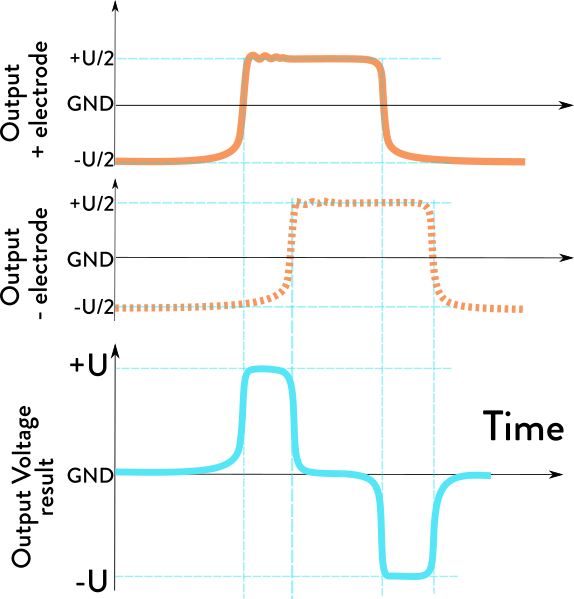
Output voltage of full-bridge driver is pulses of alternating polarity

Please, also take a look at HVSW-04 MHz-class driver with water cooling.

Input:

Voltage
+24 V DC
Current consumption
< 5.5 A

Output:

Output type
bipolar
Pulse basement1
0V, fixed
Pulse amplitude1, 2
adjustable in 0-2kV range
Maximum repetition rate2
2 MHz
Minimum repetition rate2
single shot (there is an internal restriking circuit which makes the operations at such a low repetition rate possible)
Pulse width
fixed, about 15ns in Fixed pulse width mode
100ns-2200ns or 15ns-2200ns adjustable in Variable pulse width mode,
longer on request
Minimum interpulse interval
< 100 ns in standard versions (~60 ns typically)
< 200 ns in FX version (see also How to order? section)
Rise / fall time3
6-8 ns
Delay time
<50 ns
Jitter
<0.5ns (+/- 250 ps)
Load capacitance
typ. 5-7 pF

Environment:

Operation temperature
+10 … +40 °C (wider temperature range is available on request)
Storage temperature
-20 … +60 °C
Humidity
0 ... 90%, non-condensing

Other:

Size (LxWxH)
169x60x32 mm
Weight
< 0.5 kg

1) In terms of bipolar output
2) Maximum pulse repetition rate depends on pulse amplitude, pulse amplitude and pulse repetition rate cannot achieve their maximums at the same time
3) 10-90% level, guaranteed at load capacitance 5-7 pF and below
These and other parameters might be changed upon request

Modifications

Model
Description
HVSW-03

Base version:

  • Maximum output voltage – 2kV
  • Maximum repetition rate – 2MHz
  • Rise time / fall time – 6-8ns
  • Short pulse (15ns fixed) and long pulse (100-2200ns adjustable) regimes
  • Polarity of sequential pulses – alternating
HVSW-03-FX

Version with fixed polarity of the output pulses:

  • Maximum output voltage – 2kV
  • Maximum repetition rate – 2MHz
  • Rise time / fall time – 6-8ns
  • Short pulse (15ns fixed) and long pulse (100-2200ns adjustable) regimes
  • Polarity of sequential pulses – the same
HVSW-03-WR

Version with wide pulse width adjustment range:

  • Maximum output voltage – 2kV
  • Maximum repetition rate – 2MHz
  • Rise time / fall time – 6-8ns
  • Long pulse regime only (15-2200ns adjustable)
  • Polarity of sequential pulses – alternating

You may also like